

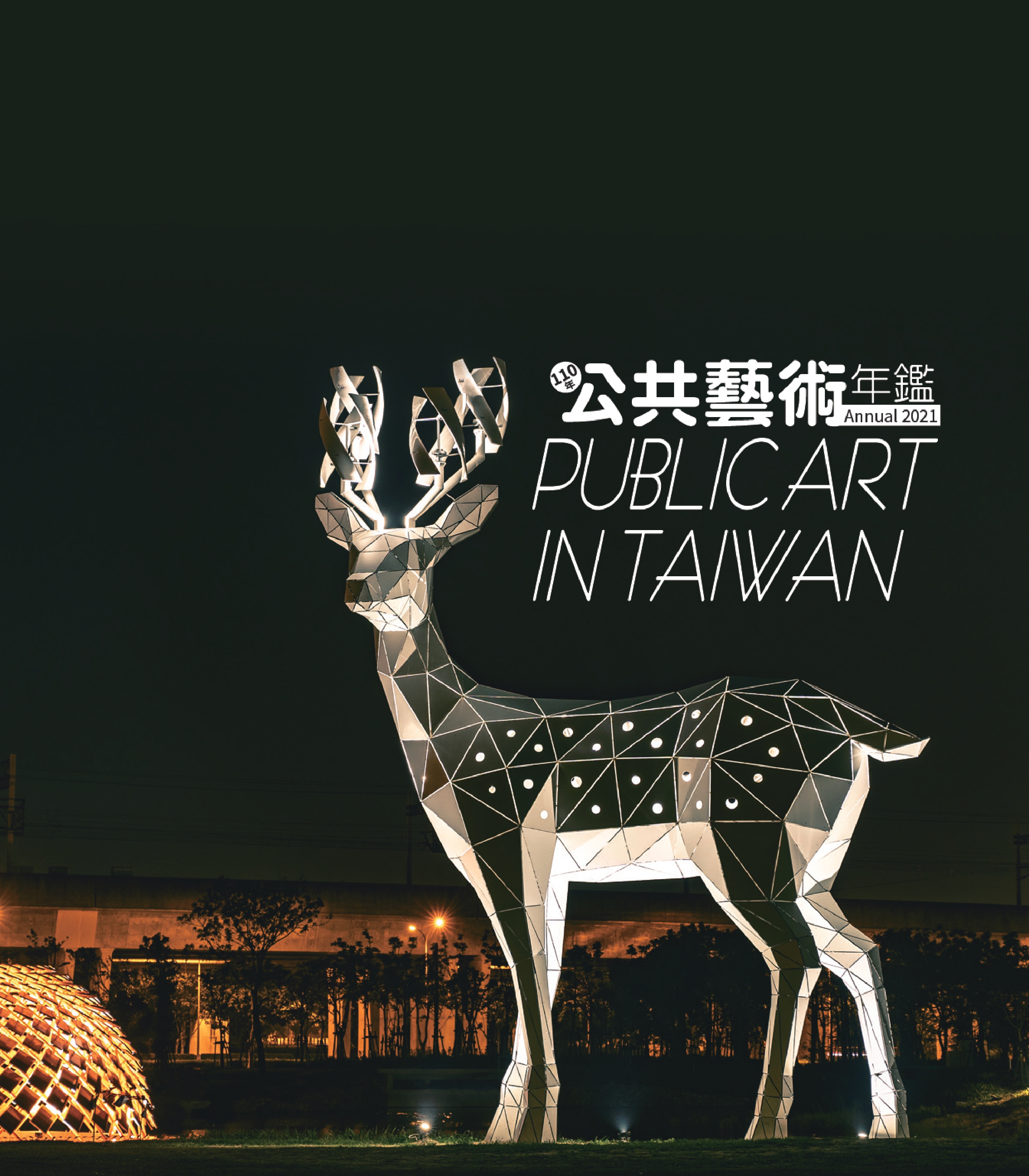
In 2021, the field of public art in Taiwan continues to advance on its existing basis andshows the trends and achievements in terms of its diverse distribution, review mechanism,creative media, ways of call for entries, and creative aesthetics. Within the gradually improved institutional environment and legal system, the public art policy in Taiwan has come of ageboth theoretically and practically. For example, the steady progress in relocating existing works and redirecting partial budget into the public art foundation, along with the trend of multicultural concern, have collectively formed a solid foundation for the advancement of public art in Taiwan. Meanwhile, the central and local governments have enacted corresponding policies in response to the impacts of the pandemic, thereby reaffirming their support for public art and artistic creation.
Over the last 30 years of development, the field of public art in Taiwan has grown into a robust system and a cornerstone of cultural policy adaptable to the changing environment. The shadow of the pandemic notwithstanding, remarkable achievements have been recognized in the field of public art in Taiwan. It proves that Taiwan has become the fertile soil in which the seeds of aesthetic experience have taken root and thrived into a lush forest of art.
1. Preface: Public Art in the Shadow of the Pandemic
In early 2020, the global outbreak of COVID-19 posed a challenge to the practice of public art in the 21st century. The fundamental principle of publicness upon which public art is based was affected to a certain extent by the pandemic. This impact was not limited to Taiwan, but also felt across national borders. Scholar Hsia Chu-joe discussed how public art served as a means of improving social interaction in public spaces (2007:18). Nakama Yuko (2010) also argued for the positive relationship between art and publicness, and emphasized the importance of creating artwork that reflected the unique characteristics of a particular location. In other words, values such as the spirit of a place (genius loci), public participation, and interactivity are viewed as progressive narratives in public art. This understanding has been acknowledged by the art world, academia, and even government agencies, and has become the mainstream contemporary thinking in public art aesthetics. In Taiwan, this spirit and principle have been incorporated into the amended Regulations on the Installation of Public Art in 2008.
However, the cultural sector typically relying on physical congregation and social interaction was particularly impacted by the pandemic (Anthony Sargent, 2021). Many official reports and surveys in Europe and the United States soon confirmed that the impact of the pandemic on the arts and cultural sector was not only severe but also structural, meaning its effects were felt from the creative and production level to the reception level (Guibert & Hyde, 2021; UCLG Culture Committee, 2020; IDEA Consult et al., 2021; Vecco et al., 2022). On the other hand, as an external factor, the pandemic has changed the way specific social spaces were used. According to The Pandemic and the Public Realm, a report published by the Urban Land Institute in 2021, many changes in the use of public spaces have occurred globally. Innovative forms of public space planning have been widely employed in response to the challenges posed by the pandemic. Among them, public art has continued to play a diverse role in creating effective creative spaces.
In June 2020, amidst the outbreak of the pandemic, Daniel Fonner and Zannie Voss conducted a research in New York which revealed a rapid decline in employment and work opportunities for artists (2020: 1-5). Many originally-planned public art projects were put on hold due to the disappearance of job and creative opportunities for artists. Similarly, Analysis: COVID-19’s Impacts on Arts and Culture by Greg Guibert and Iain Hyde highlighted the economic losses suffered by the arts and cultural sector in the US, resulting in the need for emergency subsidies from the government (2021: 4-8).
This is not unique to North America. Many freelance artists in Europe also faced challenges in their livelihoods and creative work during the pandemic. For instance, Cultural and Creative Sectors in Post-COVID-19 Europe, a report done by the European Parliament’s Committee on Culture and Education, emphasized the need for clear support for freelancers and artists in the cultural system in light of the COVID-19 outbreak. The report suggested creating better working conditions for them by revising various legal and policy frameworks and strengthening all kinds of support measures (IDEA Consult et al. 2021: 60-70).
Ryan Daniel, an Australian scholar, discussed the need for society to turn to the arts for healing and intellectual challenge in the face of the COVID-19 pandemic. Art would also be increasingly needed to help rebuild a sense
of individual and community identity. He also stated that while the pandemic would undoubtedly create economic difficulties for many artists around the world, it would also result in new artistic creations that made art an important means of rebuilding communities (Daniel, 2021). In summary, there are at least two areas of change in the public art arena in the era of the pandemic: aesthetic vision and policy support, both of which help the art world move forward and grow in the face of the threat of COVID-19. This global context raises the meaningful question of whether there have been corresponding changes in Taiwan’s public art sector.
2. The Development of Public Art in Taiwan
Taiwan's public art field has witnessed significant development over the years since the introduction of its public art policy in 1992. The policy was extensively revised in 2008 and the completion of the amendments to the Regulations on the Installation of Public Art in 2022 has ensured a robust regulatory framework for cultural governance. The data collected by the annual mainly covers three aspects: “public art installation projects,” “public art training and promotion plans,” and “public art funds.” According to the survey, there were a total of 141 public art installation projects nationwide in 2021. The top five counties and cities in terms of the number of projects were Taichung City, Tainan City, New Taipei City, Hsinchu County, and Pingtung County. In terms of the number of installed artwork, the top five counties and cities were Tainan City, Taoyuan City, Taichung City, Hsinchu County, and Taipei City.
It is noteworthy that the number of public art installation projects in each city and county showed different patterns before and after the pandemic. For example, in Taichung City, the number of installation projects in 2019 was significantly higher than those in 2020 and 2021 during the pandemic, with the 2021 figure higher than that of 2020. In Tainan City, the number of installation projects in 2020 was the highest, followed by 2021, and then 2019. In New Taipei City, the number of public art installation projects showed an increasing trend from 2019 to 2021. This indicates the top three counties and cities with the most installation projects have displayed three different patterns before and after the pandemic, pointing out that the distribution of public art projects is relatively uneven in different parts of Taiwan. Whether the pandemic has had an impact remains to be observed. From the perspective of the total number of installation projects nationwide, the pandemic has not caused significant changes from 2019 to 2021.
In terms of installation budget, except for “inter-county/city” projects, the top five counties and cities in 2021 were mainly municipalities, including Kaohsiung City, Tainan City, Taichung City, Taipei City, and New Taipei City. Overall, the total installation budget for public art in 2021 was over NT$670 million, and the annual installation budget for about 60% of counties and cities nationwide exceeded NT$10 million. In addition, there were a total of 18 projects where the budget for a single project exceeded NT$10 million, distributed throughout various regions in northern, central, southern, and eastern Taiwan, primarily in municipalities. Among them, Kaohsiung City and Taipei City even had projects whose budgets reached NT$40 million. Simply put, public art installation projects in Taiwan during the pandemic remained primarily within the scope of counties and cities, with a relatively prominent distribution in municipalities. However, in many counties and cities, public art installation projects have been carried out in both urban and rural areas, promoting the development of public art. This demonstrates that public art policy has already taken root as an important pathway for culture to enter public spaces, and has effectively mitigated the impact of the pandemic on art resource allocation in Taiwan.
3. Diverse Public Art Installations
In the public art review system in Taiwan, there are several main mechanisms, including the public art review committees of counties and cities, as well as the public art review committees of the Ministry of Culture, the Ministry of Transportation and Communications, and the Ministry of Science and Technology. With regards to the installation budget of review agencies, the largest proportion in 2021 was the public art review committees of counties and cities, followed by the public art review committees of the Ministry of Culture, the Ministry of Science and Technology, and the Ministry of Transportation and Communications, whose review processes, responsibilities, and functions are clearly defined in the Regulations on the Installation of Public Art. From 2019 to 2021, the majority of projects were handled by the public art review committees of counties and cities, with their respective mayors serving as the conveners. The review committees under different local governments can conduct reviews according to each region’s environment, history, and cultural condition.
Facilitated by various review committees, including those at the central and local government levels, the diversity of public art installations in Taiwan is evidenced by its various types and mediums of artwork. The annual pointed out three-dimensional artwork, especially sculptures, was the most common type of public art installations in 2021. However, there were also fair amounts of two-dimensional, hybrid, and other types of artwork. Formats such as installations, landscape, promotional activities, and weaving are in the scope of other types. The spatial reference of public art gives three-dimensional artwork a greater advantage in its expression, hence the greater quantity. The existence of the other three types of mediums indicates that the diversity of expression has become a prominent feature of public art creation in Taiwan.
The proportion of permanent and temporary public artwork has remained stable from 2019 to 2021, with over 90% being permanent and temporary mainly referring to short-term artistic creation activities or non-permanent installations carried out in response to project needs. The presence of permanent artwork is a defining characteristic of Taiwan’s public art landscape, scattered throughout various urban and rural spaces. In terms of artwork selection, the main methods in 2021 were public competition (70%), commissioned work (19%), and invitational (11%), with no use of methods such as targeted purchase or donation. Although the “single selection” method was mainstream in administrative terms, there were still six projects nationwide this year that adopted multiple selection methods for each project. Overall, from 2019 to 2021, “public competition” accounted for the majority, “invitational” showed a significant decrease in 2021, and the proportion of “commissioned work” has been increasing year by year. “Targeted purchase” and “donation” accounted for very little during these three years. This suggests that artwork selection processes are stable yet in diverse forms.
4. The Dialectics between Vision and Practice
The implementation of the Culture and the Arts Reward and Promotion Act in 1992 can be seen as the inception of Taiwan’s public art policy. Guided by the vision of creating an aesthetically pleasing environment, Taiwan has built a diversified public art system in terms of location distribution, review mechanisms, artistic mediums, selection methods, and creative aesthetics by 2021. Meanwhile, to bring art into daily life, diverse forms of public participation have also flourished in Taiwan’s public art domain. In 2021, drawing on previous experience, various types of public participation programs and activities have actively taken place, including artwork tours, exhibitions/lectures, workshops, related souvenirs, seminars/panel discussions/speeches, publications, and even participation in artistic creation and competitions. Among them, artwork tours, exhibitions/lectures, and workshops were the most common types between 2019 and 2021. Through diverse activities, people from different regions have more opportunities to participate in the process of public art creation, as well as share and enhance their aesthetic interests. In the dialectical development of vision and practice, the total number of public art relocation and removal is 12, and public art funds have been steadily allocated, providing Taiwan’s public art with a more flexible processing mechanism. It can be seen that the relocation and removal of existing artwork, as well as the transfer of certain expenses to funds, have become more mature within the institutional framework of our country.
Equally significant, in response to the impact of the pandemic, public art practice has proposed coping strategies, such as the “Story: Public Art Installation Project in the Era of the Pandemic in Taipei City Public Art Experimentation Program” in Taipei City and the “Yilan County Public Art Joint Creation Project” in Yilan County. These initiatives have sparked new artistic imaginations and resource investment in public art during the pandemic. In comparison to the art support measures implemented in other countries, these are equally commendable. At the same time, public art projects have continued to provide practical support to artists for their creations in the midst of the pandemic.
5. Taiwan’s Public Art Policy: Building Resilience and Long-term Commitment
Despite the impact of the pandemic, public art in Taiwan continued to thrive in 2021. The success of various outstanding projects recognized in the seventh (2021) Public Art Awards given by the Ministry of Culture is a testament to this. After 30 years of development, Taiwan’s public art policy and practice have grown into a resilient system deeply rooted in this land, forming one of the important cultural policy cornerstones of our country. Even amidst the pandemic, significant achievements were made in public art in 2021, and corresponding measures emerged adaptably on the existing foundation. All of these demonstrate that the seeds of aesthetic experiences in public art have found fertile ground and thrived in Taiwan, resulting in a rich artistic harvest both now and in the future.