

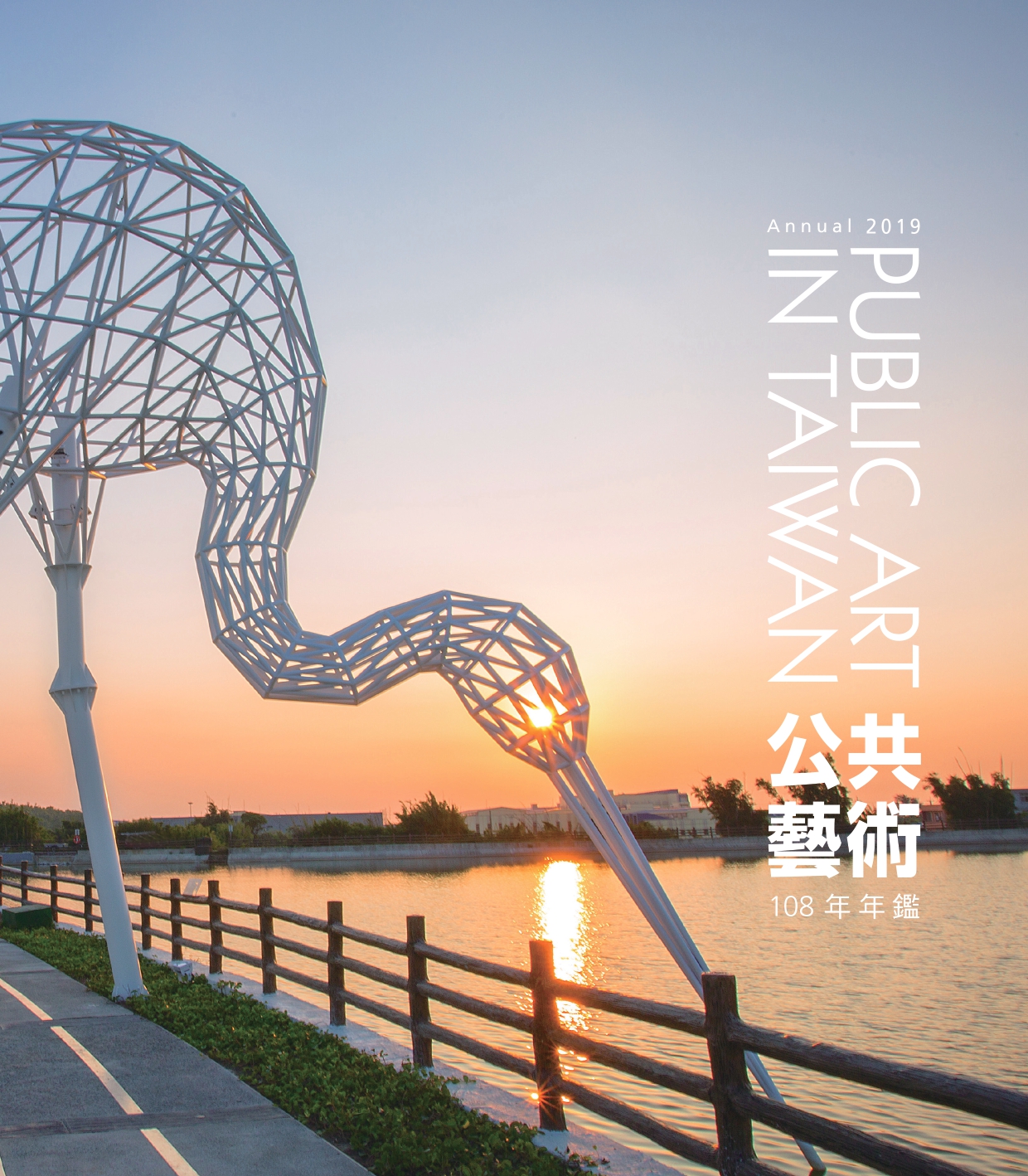
Since the "Regulations Governing the Provision of Incentives for Cultural and Artistic Pursuits" were passed by the Legislative Yuan in 1992, it is promulgated by law that 1% of the costs of all public constructions must be contributed to the installation of public art. Twenty-eight years have since passed. The Public Art Annualin Taiwan has been published annually by the Ministry of Culture since 2000, compiling in the publication all the public art projects completed in Taiwan that year and also included are analysis on the meaningful trends and phenomena observed. The Ministry of Culture then established the 1st Public Arts Awards in 2007, which is a biennial event that has been consistently held seven times since it was first launched. Artworks recognized and praised in both the annual publication and the award competition have resulted in positive pioneering and demonstration effects in related industries and also the general public. Changes and progress have also been gradually observed in the achievements accomplished in Taiwan with public art installations. However, compared with the resources and the scale of investment put into public art as a whole, the effectiveness of these changes and progress are still happening in a relatively slow pace. Why is this? Perhaps because there are many hurdles, obstacles, restrictions, and even traps found in the entire execution process for the installation of public art. After nearly 30 years since its stipulation, we ought to assertively reference past experiences to contemplate on how to make adjustments so that we could look forward to better and more exciting future public art installations in Taiwan.
Using 1% to support talented artists is more critical than cultivating public artists
First, the standards and mindset of a "public artist" after all are completely different from those of an artist striving to develop his/her body of work for many years and then achieving self-fulfillment through exhibitions or by winning awards and competitions. Some phenomena have thus been discovered: most domestic artists who are often invited to arts museums and international (non-festival) contemporary exhibitions have very low involvement in the field of "public art". On the other hand, take the artists listed in the Public Art in Taiwan Annual 2019 as an example. Conservatively speaking, it’s estimated that about 60% of these artists have no record of solo exhibitions in the past decade. This stark contrast shows that the good intention of the 1% stipulation has cultivated far more "public artists" (a paradoxical term that has appeared in recent years) than "artists" in the past two decades. Some of these outstanding creators used to be proactive about creating and publishing their own works; however, after frequently taking on public art projects, they often produce works for Party A, eroding the time and energy they need to develop their own artwork. This is an irreversible path for an artist’s career. Sometimes one misstep makes a huge difference.
The essence of public art at its inception in the early twentieth century was to create more opportunities for the public to appreciate, participate in and gain access rights to art. Another core value was that 1% of the funding could serve as a solid support system for artists in the face of inadequate government and social resources. However, the current system has indirectly caused some once productive artists to lose the balance between self-creation and public art projects, giving rise to a group of public artists who have no solo exhibition experience on their résumé and make a living by designing for various public art projects. Just think about it: how many pieces of public art created under this kind of circumstances will be worthy of passing down from generation to generation and make local residents proud?
Central to local governments should provide more comprehensive guidance to implementing agencies
Implementing agencies play a key role in the execution of public artwork installations. About 90% of implementing agencies are first timers that require professional guidance. Therefore, in order to speed up the process and reduce errors, in recent years, a model of entrusting professional agents has been gradually developed in accordance with the Regulations Governing the Installation of Public Artwork. Many projects, however, have very little funding, especially for educational institutions such as elementary and junior high schools and kindergartens, which often can be as little as hundreds of thousands to one or two million in total. After deducting administrative fees and agent fees, the remaining amount for public artwork installations is meager. However, the audience of the public artwork in these spaces are future leaders of the country who should be inspired by ingenious creativity. For a long time, there have been small-scale agents of variable quality. Of course, some are full of enthusiasm and professionalism, but it is more common to see ones that view such projects as a routine and just want to follow the timeline and get these cases closed as soon as possible, without hiccup. Providing thorough guidance to first-time implementing agencies should be a good starting point for public art projects. Implementing agencies themselves should be excited and emotional about participating in public artwork that is about to take place in their own living environment and workspace, and should have great respect and offer full assistance in the art creation.
Therefore, in addition to the public art workshops organized by the Ministry of Culture each year, cultural affairs departments of counties and cities should also be responsible for organizing several workshops respectively each year. All “Party A” that is about to become an implementing agency for public artwork in the country should send the responsible people and related supervisors to attend the course on how to implement a public art project, and the implementation can only begin after relevant training is completed.
With this preparatory consultation upfront, implementing agencies will no longer be afraid of the unfamiliar task and worry about making mistakes, thus choosing the easy way out. After having a clear understanding, they can look forward to carrying out outstanding public art projects more proactively. Clear qualitative change and improvement can therefore take place on the whole.
Public art should be planned together with buildings
In many public art selection announcements made by Party A, it is often stated upfront: public art installations must not damage the original building pavement and structure and must conform to the existing electric circuits of the building, etc. What lies at the root of the problem is that public art, right from the beginning, should be considered and planned along with the building, rather than be viewed as a decoration to make up for the architectural deficiencies after the building is completed. Most implementing agencies and architects lack this awareness at the beginning of such construction projects.
What's more, architects are usually members of the public art executive task force and the review team, but they occasionally designate and request the 1% public art funds to be used for building sign systems and color schemes, which should come from the funds for building design and implementation. They basically regard public art as a subsidiary part of the building, so the 1% is only used to purchase the "public building design and implementation" of architects’ responsibility. The nature of "art" is diluted as a result.
In light of this kind of prevailing predicament, with regard to Article 11 of the Regulations Governing the Installation of Public Artwork, the timing for the establishment of the public art executive task force should be further discussed in detail.
Architects and artists are creators worth looking forward to, and creators from different fields should work hand in hand to inspire each other by creating art in their respective forms in the same space, generating synergy by integrating architecture and public art.
Selection methods and composition of task forces should be reviewed
According to this issue of the Public Art in Taiwan Annual, although there are different forms of selection methods such as open selection, invitational selection, commissioned work, purchase, donation, etc., in 2019, 166 projects used open selection, the most frequently used method, accounting for 70% of the total projects, followed by selection by invitation (19%) with 45 projects.
So far, the Public Art Awards have been held by the Ministry of Culture for seven times. Let’s look at the winners of the fifth, sixth, and seventh "Outstanding Award": the fifth winner is “Public art installation plan for phase two of the new construction of College of Science and College of Education of National Chung Cheng University”, adopting invitational selection; the sixth winner, “Public art installation project for National Museum of Marine Science & Technology” and the seventh winner “Installation project for General Management Office of Taiwan Power Company” both used dual selection: invitational selection and open selection, where the percentage of invitational selection was higher than that of open selection.
It can be inferred that compared to open selection, selection by invitation is on average of higher quality and more secure.
However, if the results of invitational selection are obviously better, why is it less adopted? It is usually because implementing agencies that are unfamiliar with the public art selection process want to avoid the concern over under the table selection, so they tend to go with the relatively safe option: open selection. In fact, as long as the composition of the selection task force does not have under the table or self-serving issues, selection by invitation should not have the above-mentioned concern. According to the Regulations Governing the Installation of Public Artwork, members of the executive task force and the selection task force shall consist of five to nine members. In the case of selection by invitation, each task force member can nominate three artists based on their professional advice, and a long list of 15 to 27 artists will be included in the preliminary selection discussion. After exchange of opinions among task force members, there would be three to five shortlisted artists, all of whom should be of great quality and suitable for the project. The best and most suitable proposal is selected among all the excellent ones. As a result, most award winners are from selection by invitation. However, if there is a problem with invitational selection, the composition of the task forces should be reviewed. For example, in certain regions, the implementing agencies of some installation projects are used to selecting task force members from a very limited list of local experts and scholars, and a quid pro quo cycle would be formed in the long run. Ways to avoid malpractice when selecting task force members thus should be included in the training workshops for implementing agencies.
Concluding remarks
How do people usually appreciate artwork? How can it be preserved forever? When the Culture and the Arts Reward and Promotion Act took effect, the Regulations Governing the Installation of Public Artwork were yet to be perfected, the installation of many art pieces was consequently incompatible with the spaces. However, as more and more artwork was installed, “shall not relocate or demolish said artwork for five years” was added to the Regulations Governing the Installation of Public Artwork subsequently. The amendments to relevant regulations concerning the management and maintenance of artwork not only protect its installation right, but also open up new possibilities for artwork that is "in poor condition". Now is the time for a comprehensive review of the status quo of artwork installation.
This is undoubtedly an issue that must be addressed head-on after trial and error along the way.
In sum, we look forward to: making sure every step allows more outstanding artists to be properly funded by public artwork installation funds and to create their masterpieces. Local residents will in turn recognize and take pride in the artwork. This way, people will naturally be more involved in how to preserve each art piece permanently, giving full play to the value of the 1% stipulation.