
The development of public art in Taiwan over the last dozen or so years can be broadly divided into two distinct types; on the one hand, there has been much focus on the degree of freedom afforded artists in the creative process and the presentation of what they want. On the other, there has also been a tendency towards semi-anonymous creative work involving some form of public “discussion.” The first type of work speaks to the powerful personal nature of art and guiding values that permit no interference. The latter promotes shared “experience” – which is to say that only elements related to life or the nurturing of land connected to experience are sufficiently able to craft “dialogue” and thereby contribute to the completion of “public art.”
In recent years there has been much debate over these two approaches and related commentary has progressed from the written world to real “art work experience.” The results and the countless funding that paid for them clearly shows that subservience to law and customs governing “participatory events” is now a shared experience in the execution of public art. However, it also highlights the fact that “superficial” participation creates a major divergence between taking part and the thinking that underpins such events.
Generally speaking, “public participation” can be of much assistance in expanding the public nature of a piece, amplifying its art education role and enhancing dialogue between the work, local people, places, events and objects. Indeed, in some cases “public participation” can actually be transformed into the work itself. In Taiwan, the participatory activities favored by those projects funded through the 1% of legally designated construction costs, have tended to focus on the promotion of art education, particularly school campus public art. A review of project results indicates that successful “participatory events,” art education promotions and positive feedback often occur on completion of projects. In fact, it could be said that the results of such activities only become suddenly clear on hearing how moved students, parents and teachers are with participatory events and even their willingness to hold similar events in future.
Although the project undertaken by Lee Yun-shan at Yungfu Elementary School in Taipei County, adopted a participatory model that involved a specifically educational orientation the process was no less successful for that. Her work focused on simple images – clouds as allusions to freedom, equality etc. At the same time, the pieces were all imbued with a certain flexibility enabling a change in shape at any time: “At Yungfu we do not distinguish between you and me, we are all one family, happy colorful clouds: red, orange, yellow, green, blue, indigo, violet.” The project’s “participatory events” included a two-hour art class for held on six consecutive days. This enabled Lee to utilize a highly intimate framework, teaching classes closely connected to the central theme of the work.
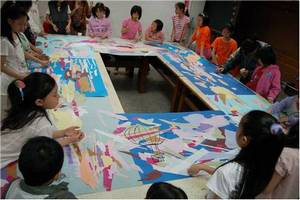
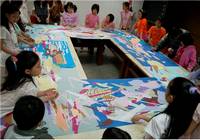
(Figure 1) Lee Shun-shan: “Colored Clouds Flying” - Students depict sky scenes using paper pieces and clippings
The work proposed by the artist for this project (installation content being determined as part of the competition rules) included a bulletin board in a corridor connecting new and old buildings, a main gate image installation, class name plaques, classroom timetables and various office signs. In terms of public (student) participation, the project promoted art education but also established a foundation for future class plaques. As part of the participatory activities, Lee Yun-shan expanded the few hours available to create an educational activity that incorporated a huge variety of elements; from 2D to 3D work, concrete to abstract, silence to sound, and also extended from the school into the local community. The six days of classes included: Class One - “Joy of Graffiti”- In this class students were encouraged to use their own imagination in painting clouds, works that were later cut into a hat-shape and worn by the students. Class Two - “Cloud Making Activity” - students first sought inspiration from picture books and were then instructed to craft their own “cloud” series of ceramic works. Class Three - “Colored Clouds Flying” - students depicted visions of the sky using paper pieces and clippings (figure 1). Class Four - “Color Tsunami” - students used watercolors, oil and clippings to depict abstract images of the cosmic sky (figure 2). Class Five - “Making Cloud Garments” - students used cotton, clay, bells and metal wire, to “knit” garments designed to make a noise when the wearer moves. Class Six - “Big Cloud Quake” - students used tools such as bamboo to produce sound-making objects. Finally, the students dressed up in the costumes designed over the previous days and organized a parade called “The Wonderful Flights and Wanderings of Clouds in the Community” (figure 2). The results of all these projects were displayed at the school for several weeks. At the same time, Lee Yun-shan also designed a “study certificate” to be presented to students on completion of the various projects.
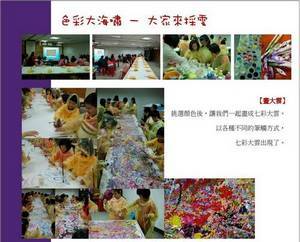
(Figure 2) Lee Yun-shan: Results of the “Color Tsunami” project. Students used watercolors, oils and clippings to depict abstract images of the cosmic sky.
The participatory events related to the public art project at Yungfu Elementary School were not notably special, their significance is to be found more in the way they ultimately convinced an initially less than enthusiastic school about the intrinsic value of “public art.” The six days of “art classes” created much impetus for expansion, in marked contrast to the “provisional nature” of most single event participatory activities. This approach made use of the comprehensive nature of the classes to first encourage students to look at things and then give free rein to their imaginations, gradually extending this to include sense of touch and hearing. The result was to create an activity that promoted fully physical involvement. In the teaching materials prepared by Lee Yun-shan she clearly stated: “We take ‘clouds’ as the central motif connecting all activities in the winter art camp. Through the application of colors, music and physical activity we seek to encourage children to use their ‘five sense’ in the creation of art.” Lee also noted the “silence” of the local community and so sought to create dynamic events that strengthened interaction between the school and community. The potential generated by the 6-day art camp was utilized to establish a “collective memory” for all students whether they directly participated or not, using “noisy’ and “talked about” participatory events that moved teachers and students alike.
Whereas the public art installation project at Yungfu Elementary School in Sanchung took one element and expanded it into six, the project at Changan Elementary School in Taipei City took deconstructed a single project into five very different elements. The creative approach adopted also involved inviting artists to attend classes at the school. This “resident artist” program was not unusual in terms of the “participatory” events organized, but the simultaneous progression of five works created a distinctive “competitive” environment.
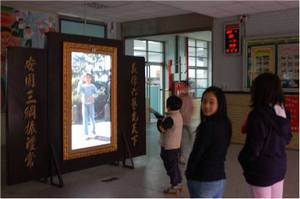
(Figure 3) Yao Jui-chung: curious “participants” stand in front of the work, keen to see themselves or classmates behaving silly.
Each one of the five artists represented a different creative style: Hou Shu-tzu, Tao Ya-lun, Huang Chung-yu, Hsu Hsun-wei and Yao Jui-chung gave art classes at the school. Hou Shu-tzu, with her interest in the way physical movement gives rise to psychological reactions, asked students to make hand shadows that were later reflected on the bodies of classmates and recorded. Tao Ya-lun focused on his long-standing interest in “motion,” encouraging the children to play with machines, toys and other simple devices. Although Yao Jui-chung is better known as an avant-garde artist, in this instance he attempted to share with students his creative work and process as it relates to “media.” The children were first asked to draw a 4 or 6-frame cartoon. Once this was completed and shared with classmates, Yao asked them to participate in a “Money Cat” performance. Students were encouraged to make their own distinctive interpretation of the popular “Money Cat” figure all of which were individually recorded. From introverted to exaggerated movements, this resulted in several hundred clips that were later built into a digital module. The final “work” was a digital screen system and sensors placed inside an old “dress mirror” standing near the main gate, so that whenever students stood in front of the mirror, a clip randomly grabbed from their “money cat” mimic performances was shown. This work is often surrounded by the “participants,” hoping to catch a glimpse of him-or-herself or their classmates making funny gestures(figure3).
The participatory events at Changan Elementary School in Taipei were somewhat diverse in nature. Indeed, so many students took part that it became a requirement. Moreover, the involvement of artists who differed creatively also helped showcase the general “philistinism” of urban schools. When compared to Yungfu Elementary School located in a more peripheral community but with a much clearer identity, the results at Changan Elementary School were more diverse and much more complex on the surface. Naturally, this was to a large extent rooted in the planning of the project, and it is no exaggeration to say that those committee members who took part in discussions and the attitude of the school itself marked the beginnings of this diversity.
With the implementation of the 1% funding law for public art, efforts moved from simple installation pieces to more complex “planned installations.” As such, “participatory events” began to play a much more important role, especially as it is impossible to convey the ideas and lasting emotional impact of cultural and art education through temporary and geographically limited events or “works.” To that end, “participatory events” have now developed through a variety of channels. In terms of private sponsorship, the “Quanta Culture and Education Foundation” has been particularly active in several elementary and junior high schools. Although they have on the whole been largely unable to take part in 1% funded public art events, the Foundation’s promotion of “participation” through “art and culture visits,” “exhibitions” and “little-tour-guide-sentry training” has already become an important supplemental source of art education for several peripheral community schools. Other “public participation activities” under the rubric of “community empowerment” or urban planning, have also sought to make more use of art education and related activities, in the hope of better combining art, land and people. The recently completed “Bright Green Campus” project at 18 schools in Taipei City is one example of the success achieved through this approach.
The six groups led by architects and artists were given a remit to breathe new life into what was originally a closed old school surrounded by a wall, through “participatory design.” Students and artists discussed the project in detail, writing down ideas and working together on the design and completion of models and draft diagrams. All such processes were both infused with democratic public discourses and also promoted art education. The new walls that have been built at Beitou Elementary School, Fuxing High School, Zhishan Elementary School are a testament not just to the creative talents of the artist but also to the values of the school themselves – a willingness to put issues of authority to one side and allow “users” and “viewers” to give voice to their feelings. In point of fact, all art-oriented “participatory events” (that fall within the 1% public art funding or other categories) are imbued with an approval based on trust and the results represent growth for each and every participant.
I very much hope that those government officials and artists who consider “participatory events” to be little more than contractual requirements take a closer look at the cases presented here and finally come to realize that this is an opportunity that can change things far more than they ever imagined.