

Art is One Choice for Community Development
Chutsaichiao settlement is located in the Houpi District of Tainan City and is one of six areas that make up Tukou Burough (village). It has a population of about 30 households and, as with many modern rural areas, a high number of seniors and children. Established in 2002, the Tukou Rural Cultural Development Association has worked to transform the community, selecting the water buffalo as a symbol of local spirit and seeking to awaken in the younger generation shared memories of their hometown. Over the years, the group has promoted ox-cart parades, ox-cart installations, water buffalo stone sculpture art installations and Golden Rice Field Cultural activities. At that time, cultural policy attached a great deal of importance to community development and public art in Taiwan was in it infancy, so there was little interaction between art and communities. However, with such meager funding the participation of local residents became extremely important and it is against this unique configuration of conditions that a mechanism for artistic participation gradually became a key element of the community development process.
Through community development work the residents of rural Tukou came to understand that if they did not seize the opportunity to define themselves something far more staid and unimaginative was likely to be imposed from above. As such, the area sought to use art as a prism to interpret rural life and showcase its life values. After a number of successes in the field of community art over the past few years, Tukou Rural Cultural Development Association became more ambitious. With that came the recognition that embracing art required going beyond the green beautification framework of community development. This is true because artistic values should always help to enhance the way residents identify with local life. However, questions still remained: How should art be undertaken in a real world living environment and how can art best showcase the quality and refinement of rural life?
First Life, Then Art
The artistic development of living space in Chutsaichiao settlement has transformed rural Tukou into an important artistic landmark in the name of life. In the past, efforts to develop community space had mainly focused on idle or empty spaces, whereas this project involved an area where people lived, making the interplay of life and art far more complex. Moreover, this was also the first such experiment in rural Tukou. Although the area had achieved much in terms of community development over the years, trying to make art an integral part of daily life was bound the meet with some resistance from local residents. Village head Chang Chia-hui repeatedly worried whether the community was ready or the time was right for the project. In the year before the Council for Cultural Affairs proposed the idea, Tukou village conducted an experiment in Chutsaichiao, encouraging local residents to develop space without the assistance of public funding so as to gauge the level of interest and passion. For one year, how the environment was maintained and managed was closely observed and as soon as residents were deemed ready the planned encounter between art and Chutsaichiao was officially launched.
In an era in which community development and artistic experience collide, the first question has to be whether residents and artists are ready? With so little construction rural areas account for less than 1 percent of expenditure on public art and annual artistic celebrations and festivals invariably neglect the countryside. In other words, there were few examples of bringing together rural communities and art in Taiwan to serve as a reference point for the project. At the same time, only a handful of artists had ever created art in a community setting. In this case, the Council for Cultural Affairs provided only NT$650,000 in funding which, based on market prices, was barely enough to buy and install one work of art, making dreams of transforming the community somewhat fanciful. Faced with such financial constraints, artists who would blend into the living environment were chosen over those who were better known. Although given the prevailing conditions, transforming the community presented an extremely difficult challenge, the Tukou Rural Cultural Development Association still believed that the combination of a group of carefree farmers and passionate artists focused on life, with a rural backdrop as their canvas and local stories retold through art, had an intrinsic value that transcended the hallowed halls of artistic opulence.
Multi-Layered Participation
The artistic transformation of space usually involves private space which makes it difficult to impose a fixed mode of participation. When determining how people should participate, projects invariably seek a method that allows everyone to express their opinions and ideas, which becomes part of an interactive model attached to a specific area. It is through the process of self-creation that the work is completed. However, this model was clearly not going to work in Chutsaichiao, because all the space there was private. That meant neighbors and friends were unwilling to make proposals, and when it came to participating many were worried about getting things wrong and damaging relationships. As such, it was necessary to first establish conditions at each individual site before work could proceed; 1) The owners of the land in question must volunteer to take part and maintain the art; 2) Once a work was completed the group should collectively move on to another creative space. These conditions were designed to act as a catalyst, so that projects followed in quick succession and everyone in the village worked together. After the work was completed, the residents of Chutsaichiao set about tidying up those areas that could not be transformed and then held a ritual to thank the Land God. This involved praying in front of the main gate of each home and asking the deity to protect the settlement.
An Artistic Interpretation of the Spirit of Peace
“Peaceful life” is the central theme of the Chutsaichiao artistic settlement development. That term represents the profound memories people share of home in a rural village. Chutsaichiao is imbued with the carefree and self-content rural philosophy of farmers, though it is also informed by a longing for the children and grandchildren who have moved away.
In Chutsaichiao, housewives still use shoulder-poles to carry loads to temple celebrations as they have done for generations and the use of ghost money and red envelope at the door of the family home is a physical representation of how much children and grandchildren are missed. In the morning and at night, grandmothers piously burn incense and ask the Gods to protect their offspring as they make their way in the outside world. In other words, the philosophy of contentment embraced by the farmers and their desire for a peaceful life is imprinted on the shared memories of rural life.
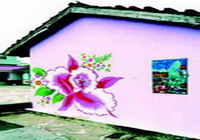
The concept of a “peaceful life” provides a framework within which artists and local residents engaged in dialogue, the easy going philosophy of rural existence being an important source of inspiration. Singer Yen Yung wrote the Peaceful Chutsaichiao series of compositions in which he sang about the romance of rural life; stone sculptor Hou Chia-fu used a snail as a spiritual symbol of “peaceful life.” Bucolic painter Yin Chia-hui painted red peonies on a wall to represent marriage and the sweet memories of happy times; video artist Liao Kuo-hsiung overlapped images from memories of time and space; Artist Chen Yu-liang created Ten Minutes with Tao Yuanming, which reflected on the emotional landscape of rural life. The fountainhead of all art is life and through art it is possible to immerse ourselves in the life of a rural community.
Art is More than a Choice, an Artistic Countryside is a Dream
Although the “Peaceful Life in Chutsaichiao” project has finished, artistic dreams continue. A year after the project, Hou Chia-fu established a “Tukou Art Workshop” in Chutsaichiao, becoming the latest addition to the local community. The local housewives have been no less busy, establishing a Tokou Rural Art Studio with the assistance of painter Chen Shu-hui. Grandmother Chang Chao-tao even set up her own art studio, swapping the hoe for a paintbrush and immersing herself in the joy of creating art.
Tainan National University of the Arts (TNUA) graduate students Tsai Chia-yin and Wei Wan-ju created Country Road, a spatial art work in which thy successfully applied the Chutsaichiao experience in another rural location. In addition, TNUA students who took part in that project, Chen Yu-liang, Lu Yao-chung and Chang Lung-chi, took up residence in Tukou after graduating and in August 2011 established the Country Art Group, which has called on young people across Taiwan to take part in a “dream building” rural art installation art program.
This coming together of community and art facilitated the swapping of agriculture for art and the relocation of art from the marbled halls of museums and galleries to the countryside. Participation in the Tukou art project was a living, breathing act, and the transformation of the settlement is to be found not in the infrastructure of the area, but rather in the decade-long process and the dreams that so many people still have for this place and Tukou art village.