
I would like to thank the jury panel members for choosing “Public Art Installation for Stage One of a School Building Project at Yongfu Elementary School, Sanchung District, New Taipei City.” Having been involved with public art for nearly a decade receiving a “Best Education Extension Award” for the “Yongfu Flying Clouds” art camp has been encouraging and deeply moving.
Art pursues myriad possibilities and the ongoing process of overturning and reconstruction fosters boundless creative sparks. In contrast, public art involves achieving an objective within fixed parameters which despite being an apparent contradiction can also give rise to great creativity. I first encountered public art in 1997 when I went to Tainan College of the Arts (renamed Tainan National University of the Arts in 2002) headed by Mr. Han Pao-te. At that time, the college promoted the “integration of art and life” and the open experimental attitude on campus encouraged students and teachers to rethink the balance between “art,” “space” and “public” aspects of a work. Public art related subjects essentially seek to establish a dialogue between creative energy and space. In this context, the artist utilizes his or her unique persona to convey the emotional nature of the materials which combined with humanistic and cultural awareness makes it possible to view spatial possibilities from an artistic point of view. By controlling these elements and the quality of the dialogue artistic and public facets can be integrated as a single work.
The successful execution of public art involves the coming together of people, events and objects. In the past, public participation tended to be based on community building and adopted “formal equality” as a way of “reducing the distance between art and viewers.” However, this approach often became something akin to a fireworks display and left many participants still only half understanding “art.”
Whenever I start a work of art the first thing I do is ask: “What exactly is art?” and “What is public art?” I also tried to make this process of exploration and creation an integral part of art camp. Over the last 27 years Yongfu Elementary School has taught countless children from the Sanchung area and during that time undergone much change, a prime example being the construction of a new school building which will provide the district with a more modern teaching space. This piece grows organically out of the local area and culture, utilizing artistic methods to convey the drive of the place in the hope of expressing the vitality and diversity of basic elementary school education through flowing shapes and rich colors.
Public art works are often large collective projects and because they involve so many people - conveners, jury panel members (professionals), executors (installation agencies / art administration companies), competition participants (artists), appraisers (county and city level cultural bureaus) and users (the public) – the quality at any one of these stages can impact the outcome. At the same time, the diversity generated by the involvement of five levels of participants with different approaches and viewpoints is an indispensible element of the creative process. As such, the art camp activity, which the organizers originally wanted the artist to organize in addition to the public art work, was transformed into “a vehicle to enhance understanding and acceptance of the environment and oneself.” In this way, the school’s approach to academic studies and expectations of students received the full support of parents, teachers and students through the expression of public art. This also enhanced public awareness and concern for public issues.
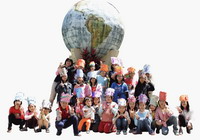
The work “Yongfu Flying Clouds” started life as simple image symbols – clouds as an allusion to freedom and equality. At Yongfu School there is no you and me, only family, and all the colors of the rainbow: red, orange, yellow, green, blue, indigo and violet.” The classes held at art camp were organized so that children could experience the spirit of art first hand through artistic creation rather than through writing or listening to artists. In other words, the objective was for the children to gain a better understanding and acceptance of themselves and the environment by engaging in and experiencing art through their own senses. By working together to create these pieces everyone involved experienced the immensity of creativity.
“Yongfu” is a place of eternal happiness, so it was my intention to use the creative work at art camp to convey the power of art I experience when creating. The aim was to encourage the children to tap into their own inner creative energy through real world practice and learning - that is the underlying spirit of art and the origin of happiness.
The clouds in the sky wander the boundless heavens with no fixed form and no class differences, just as all citizens have the right to receive the same basic elementary school education. Teachers educate students in accordance with their aptitude, encouraging them to learn, pursue their dreams and give rein to creativity. We expect every child who attends Yongfu Elementary School to “grow and learn in a happy environment.” It is our hope that during their time at the school, they will establish their own life values, cultivate self confidence and develop a well rounded character. As such, the use of clouds as a symbol to connect the space and identification system employed by the school represents an effort to encourage the free development of all children. In this framework, teachers are like the sky, providing a comprehensive education to students from a wide range of different backgrounds.
Through experience and creativity the aesthetics education taught at the school is extended. Each activity and artistic dialogue taught the children how to develop a broader vision and better understanding of beauty from different perspectives. The sparks that arose from brainstorming created a shared memory for the school and because most of the participants were students who live in the surrounding area the use of divergent activities enabled them to experience something completely new. Through the interactive nature of this process creating art was also used to guide the event from self discovery to school spirit, thereby establishing an emotional connection with the new school building and the local community. This also ensured that participants identified with the public art work they helped to create.
I was extremely thankful to encounter a school principal and teaching staff who very quickly got behind this project, because it was only with their support that what started life as an idea became a reality. Together we watched in wonder as artistic ideas took root and blossomed at Yongfu Elementary School. The Best Education Extension Award is an affirmation of the hard work by everyone involved in the project, but I would also like to thank the Ministry of Culture for organizing the 3rd Public Art Awards and members of the jury panel for their support. A special mention also for Yongfu Elementary School principal Hung Yao-ho and department head Wang Yi-cheng; the public art team (Expansion Creativity Ltd. Co.,) and teachers Yang Ya-ling, Lee Hsuen-pei and Chen Yi-chin. The single most important element for the success of this public art project was the participation of the children because what they put into the project far exceeded our expectations. It also demonstrated to all the adults involved the incredible strength of the creativity that can be created when art and life are brought together. This outcome renews and reinvigorates our determination to continue promoting art as an indispensible part of life.