

Long before public art existed as a concept, in the 1970s National Tsinghua University invited landscape sculptor Yang Ying-feng to design its campus grounds as a result of which several landscape sculptures were created. These two cement sculptors made use of the simplicity and unadorned nature of the medium to reflect the traditional gentle and cultivated school spirit of Tsing Hua University. The landscape sculpture of the school emblem at the main gates presents visitors with an image of an old style booklet made of bamboo strips. This has three parallel concrete pillars and in the middle three decorative horizontal lines similar to the string used to ties such ancient books together. Through the artist’s ingenious creative design, the school emblem is showcased as lofty, tenacious and strong, signifying that the students who pass through these halls of learning are set to turn a new page in the their academic careers. Located next to the climbing poles on the sports field, the work “Sublimation” expresses the boundless majestic ideas of landscape sculpture. The way in which it appears to extend directly out of the ground and its soul stirring manner, especially the energy and untrammeled nature of the mountain wall pattern is an example of how the landscape sculptor employs his distinctive style to discourse on geographical phenomena in Taiwan. The work “Phoenix” is next to the grassy area and pine trees directly in front of the main hall and showcases a shared memory imbued with warmth and emotion. Many alumni often revisit the piece and although it is not smooth and round in shape, the steadfast and robust image of a young bird is also infused with a simplicity and freshness.
Following the passing of the third reading of the Culture and Arts Reward Act by the national legislature and before the passing and implementation of the Public Art Installation Measures, National Tsinghua University organized the first ever competitive tender for public art. First prize was won by artists Chen Cheng-hsun, Hsiao Li-hung from the Bamboo Curtain Studio with students and teachers from the Department of Mechanical Engineering and is located near the entrance to Kungyi building near the main gate. Using money left over from the construction of a new building, their work, “The Process” details the circular relationship between life, learning and interactions between individuals. As part of this piece 1,000 Basque pelota balls on a large circular plate at the bottom of the work are fed into a winding transparent pipe in the ceiling and surge towards a transparent pipe in the wall, from where they drop to the floor and roll back to the starting point, a cycle that repeats itself ad infinitum. Although this work has been here for nearly 20 years and its internal mechanism has aged, careful upkeep ensures that the power cycle continues to operate.
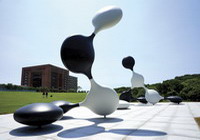
Wang Tsun-wu’s work “Clear Mirror” is one of the earliest works of public art in Taiwan and was paid for with money left over from a national public art demonstration project planned by the Council for Cultural Affairs. The years when the Ministry of Education was in charge of national university projects was the peak period for public art at National Tsing Hua University and included such renowned works as Lin Po-jui’s “Migrating Bird Returns Home,” , Tsai Cheng-wei’s “Meeting Science” and Hsin Kuan-chin’s “Silent Dialogue.” Lin uses pure hues and simple shapes to create an artistic space that is both welcoming and happy, where people can not only relax their weary limbs after traveling, but also seek spiritual tranquility. Although travelers drift from place to place, visiting faraway places in search of their ideals, but even if one works or travels night and day individuals always return to the rich warmth of home to rest. Tsai resolves to create a work of public art reminiscent of the magnificence he witnessed in the La Defense District of Paris. The work “Meeting Science” in the outdoor upper section of the high ceilinged area of the TSMC building has become a bright point in the local landscape. Seen from a distance the eye-catching red cubes, blue cones, circular pipes and spheres craft refined romantic lines, that imperceptibly improve the feel of the surrounding environment like the urban spatial focal lines of French new towns. World renowned artist Susumu Shingu grasps the principles of mechanical kinetics and in the field of kinetic sculpture has vividly developed kinetic art to new heights. He is particularly adept at combining works of art and mechanical principles, biodynamics and artistic ideas, utilizing wind, water, light and shade to create an elegant dialogue between the work and the environment in which it stands engage, thereby showcasing the elegance and talent of Mother Nature.
This year National Tsinghua University added two works of public art to its collection; “Yi Yuan” and “Ching Chai”, the latter of which is located in the central plaza of the dormitory area. This public art work was designed by Yan Chih-fu and glass artist Kuo Yuan-sen, is made up of four colored metal structured elements, as if it is arms are open in a welcoming embrace to greet students from all over the world. Viewers can experience first hand the warm hues and color system crafted by the artist and can move to different fixed positions to better see first hand the divergent ways in which the colors of the metal structures overlap and combine. The artists introduce an experimental artistic form into the space and as a result the flow of consciousness in that moment re-structures every interaction of artistic language. Viewers also become elements in the presentation of this creative variation, which through the dialectics of artistic language and process of imagination brings realization and enlightenment. In this way, teachers and student can leisurely experience the energy, boundless imagination and cognitive capabilities of art.
The campus is also home to many works of art that were produced without the use of public art funding such as a new “sundial”, or the sculpture piece “Stain”, which is outside the library and was donated by artist Kao Chieh-hsing after taking up residency at the school. This piece is a combination of hard and soft elements and the hand welded surfaces are refined and smooth, with a shape that is virtual and real, profound and romantic. Artistic areas can be found by following the clues on the campus art and cultural map. This art includes the locations of all public art and art venues on campus and was originally designed for teachers and student, but then unexpectedly became a blueprint for other schools that wanted to create their own art maps or collective art projects. There even examples of art lovers overseas seeking out the maps, so that an object which folded can fit in the palm of one’s hand has had an extraordinary impact. I have always believed that that the aesthetic viewpoint represented by public art is highly diverse, regardless of whether you praise or criticize the pieces on show, it still encourages they still encourage the public to pay greater attention to the environment, to show greater concern for and participate in related events, while fostering emotional interaction and dialogue.