

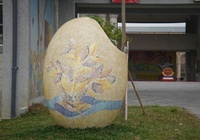
We always tend to avoid discussing death, disappearing, ceasing to be; somehow these are viewed as “negative” topics that shouldn’t be talked about. Whenever a new work of public art is born, we image that it is going to last forever, but in reality the destruction of a work of art can come very suddenly. A piece of public art can disappear because it has not been properly maintained, or because it has been located in an unsuitable environment, or because of changes in the surrounding environment; all of these factors can lead either to the physical destruction of a work, or to the destruction of the spiritual relationship between the work and its venue.
Since the Regulations Governing the Installation of Public Artwork came into effect, people have gradually started to become more aware of these issues, and to discuss them. What the issues highlight is that the fundamental problems affecting the management and maintenance of public art works are fear and uncertainty. When people lack the specialist knowledge needed to look after works properly, this can lead to ill-advised “maintenance” that ends up causing even more harm.
There is an urgent need for the formulation of standard operating procedures governing the removal and relocation of public art works, so that the authorities have a clearer idea as to how to handle these works properly. Public art works that were installed just over a decade ago are now stuck in an embarrassing limbo where no decision can be reached as to if and how they should be removed.
What can be done to prevent the spatial significance of public art works from being damaged during the process of maintaining them? How can administrative measures be used to help the responsible agencies adopt more appropriate attitudes towards maintenance management? How can the specialist know-how for handling works be acquired, so that the artist’s rights in their creation can be more effectively protected from harm caused by a lack of expertise? Can the problems of physical damage to public art works and destruction of the spiritual significance of such works be addressed by creating new laws (or revising existing legislation), by giving supervisory bodies the authority to take concrete action, or by establishing a new guidance mechanism, with third-party agencies being commissioned to implement surveys and monitoring, while at the same time promoting educational initiatives, so that relevant agencies come to attach more importance to the long-term maintenance and management of public art works?
Article 27 of the Regulations Governing the Installation of Public Artwork stipulates that: “Once the installation of a public art work has been completed, the agency responsible for management of said public art shall include the work in its asset management operations; the work may not be relocated or dismantled until a period of at least five years has elapsed. However, this provision shall not apply in cases where the cost of maintaining a public art work exceeds one-third of the initial installation cost, or where there are other special circumstances, and approval for the relocation or dismantling has been given by the relevant supervisory board.” According to this provision, once a public art work has been installed for over five years, the authorities are permitted to consider removing or dismantling it.
As to what constitutes “special circumstances,” from the point of view of the agencies responsible for managing public art works, there are few precedents to follow. Consequently, when an agency does find itself needing to relocate a work, it is often at a loss as to how to go about it, or else comes up with a relocation plan that is unsatisfactory, in which case the supervisory board is unlikely to approve the plan; this has resulted in the current situation where agencies find it very hard to remove works. Following extensive observation and research, this article offers a case study of the public art relocation policy adopted by the city of Edmonton in Canada.
Edmonton city government takes the view that public art works constitute an important asset for the city’s residents. The city government believes that, provided they are properly maintained, public art works can become more important and more valuable over time, coming to be seen as irreplaceable cultural assets and landmarks.
At the same time, if an art work is not properly cared for, then in a very short space of time it can become a public safety risk, and the maintenance costs can escalate dramatically, possibly making it necessary to relocate or dismantle the work. Furthermore, works of art that are not properly looked after can lead the general public to have a negative impression of public art and of the city as a whole. For this reason, Edmonton city government works actively to maintain and preserve public art works belonging to the city, but also dismantles and relocates them when necessary.
The city government has compiled a list of six situations in which public art works need to be dismantled or relocated:
1. Where the work in question will fall apart if left in its original location;
2. Where the place where the work is located has changed, and the work is no longer appropriate for that location;
3. Where the work will pose a latent threat to public safety if left in its current location;
4. Where the cost of maintaining or restoring the work is excessively high;
5. Where the general public has had a recorded, verifiable negative reaction to the work over an extended period (usually the work will have been installed as public art for a period of at least 10 years before this determination is made);
6. Where both the Edmonton Arts Council and Edmonton city government agree that the art work in question no longer conforms to the criteria for designation as a public art work.
Even if one or more of the above does apply to a particular public art work, the work will still be subjected to a rigorous evaluation process before a final decision is made. If the Edmonton Arts Council does decide that a work needs to be relocated, then the city government will decide on a new location for the work based on the recommendation of the Public Art Committee. The decision will take into account how well the new location is suited to the work, and how well the work is suited to the location, as well as how receptive the local community is to hosting the work. If the Public Art Committee decides that a given work should be sold off, then the original creator of the work will be given first right of refusal (and in some cases the work may simply be given back to the artist free of charge). If the artist decides that they do not want to buy the work back, then the Committee will accept the artist’s decision as to whether the work should be auctioned off or donated to an Edmonton city government agency.
Public art works normally obtain that status through a formal procedure of evaluation, approval and review, and once the work has been designated as public art it is usually subject to rigorous registration and management procedures. It is therefore important that, when a public art work needs to be withdrawn from display, there should be a proper, public-minded procedure in place to govern the process of removal. The procedure should incorporate “trigger” conditions that justify removal, as well as a removal plan that corresponds to the original installation plan; it should also provide for the establishment of a removal implementation team, and for ensuring that there is adequate discussion and communication. The final decision should be left to a review committee, taking into account the plans made for disposing of the work after removal.
Given the complexity of the process through which public art works come into being, there is no reason why the processes for maintaining and disposing of public art works should be slapdash. In particular, with regard to the procedure for periodic maintenance and the mechanism for eventual removal, it is recommended that the responsible agency should arrange for a third-party body to perform regular inspection, or alternatively to invite public participation, so that the public as a whole is able to supervise the management of public art works (which are, after all, public property), thereby avoiding the situation where a work starts to deteriorate without anyone even noticing. There is no material that can remain pristine forever, and there is no environment that will remain unchanged forever, but if a public art work has to be retired, or relocated to enjoy a new life somewhere else, then it should be possible for this to be done in such a way that the work is still accorded due dignity and respect.